REDEFINING STANDARDS EVOLUTION
REDEFINING STANDARDS EVOLUTION
Standards Intelligence is the capability to understand, apply, and adapt to evolving business standards while preserving their meaning, context, and relationships.
WHAT WE BELIEVE
The next evolution isn't new standards.
It's making standards operational.
Standards are documentation: Standards Intelligence makes a document mutually intelligible across every version of a standard, it's subset, and representation — Reactor instantiates it in runtime.
Key Insights
Modern integration architecture strives for loosely coupled, independent systems.
Yet as business standards evolve through new versions, syntaxes, semantic changes, and implementation variations, those loosely coupled systems gradually become statically coupled through accumulated standards dependencies, rather than through the architecture itself.
The result is hidden coupling through standards. Each standards change introduces new mappings, transformations, documentation, and manual knowledge, increasing complexity and reducing architectural independence.
Semantic divergence example for OAGIS/connectSpec:
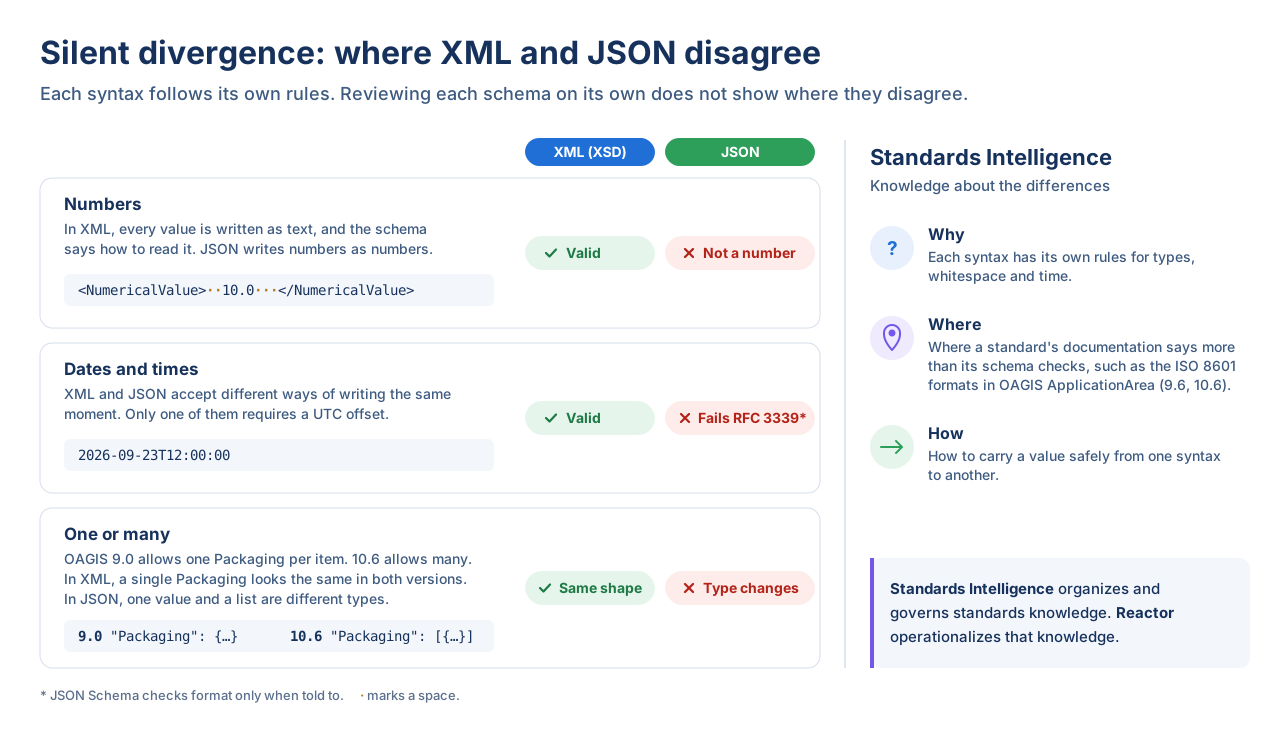
Turning standards into knowledge, and knowledge into understanding, is what enables organizations to preserve interoperability without recreating that coupling.
Interoperability complexity is not primarily a connectivity challenge—it is a standards knowledge challenge.
Yet as business standards evolve through new versions, syntaxes, semantic changes, and implementation variations, those systems gradually become tightly coupled to the implementation details of the standards themselves.
The result is hidden semantic coupling. Every standards change introduces new mappings, transformations, documentation, and manual knowledge, increasing complexity and reducing architectural independence.
Transforming standards into knowledge—and knowledge into understanding—is what enables organizations to preserve interoperability without recreating that coupling.
What Standards Intelligence does
Standards Intelligence organizes standards knowledge into an operational understanding of how business standards relate, evolve, and preserve meaning.
Rather than treating each version, syntax, or implementation as an isolated integration problem, it continuously maintains the relationships and business context across supported standards and versions.
The relationship between versions and representations is calculated rather than maintained as a separate mapping for every pair.
This understanding lets systems evolve independently while maintaining a shared interpretation of business information.
Learn more about Standards Intelligence and Reactor in Questions & Answers.
Reactor operationalizes
standards knowledge.
Reactor operationalizes standards knowledge, maintains contextual understanding as standards evolve, and applies that understanding to interoperability across organizations, processes, systems, standards, versions, and syntaxes.
The result is a resilient standards knowledge layer that reduces coupling through standards, enabling architectural independence while preserving business meaning, governance, compliance, and traceability as standards continue to evolve.
Read how Reactor works.
"Reactor transforms standards knowledge from static documentation into an operational capability that evolves with your business."