About Us
Synctrion was founded in 2025 on an observation first made in 2012: interoperability remains difficult despite decades of investment in integration technologies.
While organizations have become increasingly effective at connecting systems and moving information, they continue to face challenges in understanding evolving standards, maintaining semantic consistency, governing change, and preserving interoperability across complex ecosystems.
We believe interoperability complexity is a standards knowledge problem, not a connectivity problem. Our mission is to turn standards knowledge into actionable intelligence, enabling organizations to navigate interoperability with greater clarity, confidence, and sustainability as business evolves.
This belief led to the creation of Reactor. Rather than treating standards as static specifications that must be repeatedly interpreted and implemented, Reactor is being built to turn standards into intelligent, configurable assets that support interoperability across systems, versions, and syntaxes while preserving business meaning.
We see this as a fundamental shift: from implementing standards as documentation to operationalizing standards as intelligence. By helping organizations understand the standards that define their information, we aim to reduce complexity, improve decision-making, and support a more connected digital future.
Reactor
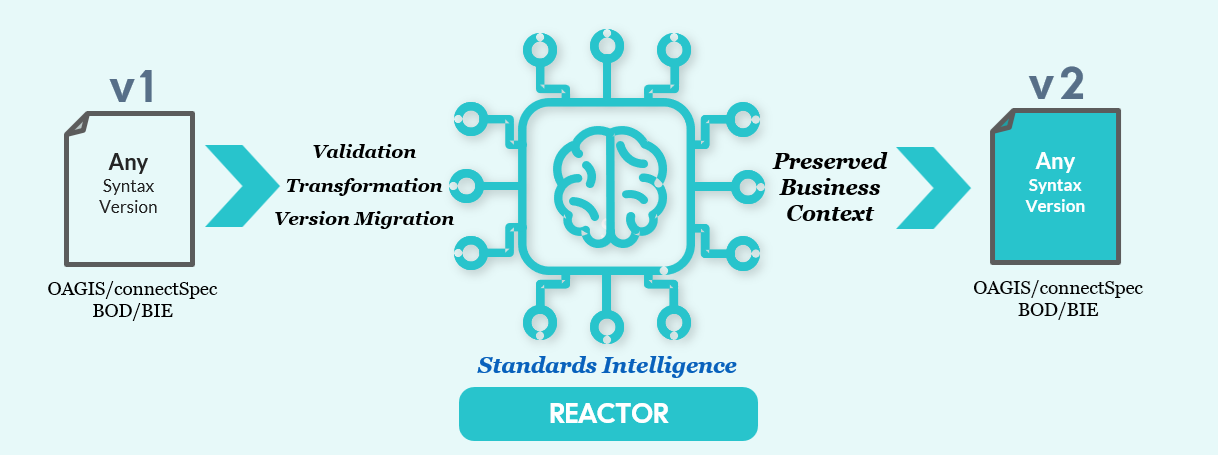
Our initial mission was to enable interoperability across versions and syntaxes of OAGIS/connectSpec standards published by OAGi (Open Applications Group), a global leader in open interoperability standards used by many of the world's largest enterprises.
To achieve this, we needed to embed deep, programmatic knowledge of these standards directly into the integration processes. Developing Reactor taught us to better understand how standards knowledge enables automated and configurable stateless decision-making for features such as data validation, transformation, and version migration across standards versions and representations, while preserving business meaning.
Developing these feature capabilities revealed a broader opportunity: standards knowledge itself could become an operational asset.
That insight became the foundation of Synctrion's Standards Intelligence. The concepts behind Reactor are explained in more detail in our Questions and Answers.
The concepts behind Reactor are explained in more detail in our Questions & Answers.
Proven Collaboration
In September 2025, Synctrion presented the first beta demonstration of Reactor to OAGi. This milestone marked an important validation of a new interoperability approach based on Standards Intelligence.
Building on this collaboration, Synctrion become the first company to earn the OAGi Platinum partnership in 2026. This partnership reflects a shared commitment to advancing open standards, accelerating global interoperability, and enabling more adaptive and resilient digital ecosystems.
Read more about the OAGi Platinum Partnership.
Why We Are Different
Traditional integration approaches require organizations to continuously adapt systems to evolving standards, creating complexity, duplication, and long-term maintenance overhead.
Synctrion takes a different approach: we enable OAGIS/connectSpec standards themselves to become intelligent and adaptable across systems.
Instead of encoding business rules and transformations repeatedly across integrations, Reactor centralizes standards knowledge as executable intelligence. This allows interoperability to be governed consistently, regardless of system, version, or syntax.
The result is interoperability that is not only connected—but coordinated, consistent, and evolvable.
Learn more about Why Us

Trust by Design
Trust is a foundational principle of our architecture. Reactor is designed to process contextual structure rather than business content.
The platform validates standards-defined rules and contextual metadata required to deliver interoperability services, while minimizing exposure to customer business data. For example: ISO 8601 date and time validation.
We do not analyze customer business content using artificial intelligence, machine learning, analytics, profiling, or content interpretation systems. Instead, we focus on validating structure, context, security mechanisms, and transactional integrity defined by standards.
Only transactional information required for traceability, governance, auditing, and operational monitoring is retained where necessary.
This separation of business context from business content supports interoperability capabilities while organizations maintain control over their data and governance requirements.
Our Mission
Our mission is to unlock the full value of open standards by making interoperability intelligent, configurable, and sustainable.
We enable organizations to move beyond traditional integration constraints and build digital foundations that support long-term growth, operational efficiency, and business resilience.
Our Perspectives
We believe business standards are more than technical specifications—they are the foundation of connected digital ecosystems.
We believe interoperability should not be constrained by technology stacks, vendors, or evolving versions of standards, but should instead be governed through intelligent, standards-based logic.
We believe organizations should be able to exchange information consistently, preserve meaning across systems, and adapt to change without introducing unnecessary complexity.
Most importantly, we believe that when standards become executable intelligence, they unlock a new model of enterprise interoperability—one where automation, governance, and collaboration are intrinsic rather than added on.
By advancing Standards Intelligence through standards-driven ecosystems, we are helping build a future where growth, operational efficiency, and resilience are not competing priorities, but natural outcomes of connected enterprises.
We belive the result is a world where organizations scale together—creating lasting economic, operational, and environmental value for businesses, communities, and the planet.
Learn more in Why Us